

National has slipped to 24.8 per cent in the latest RNZ-Reid Research poll, below the 25.6 per cent it recorded at its 2020 election defeat, with nine days until polls close on 7 November.
The poll, published on Thursday morning, has Labour on 30.6 per cent, the Greens on 14.5, ACT on 10.1, NZ First on 9.9 and the Opportunity Party on 7.2 per cent, up 1.7 points and well clear of the 5 per cent threshold. Te Pāti Māori was on 1.9 per cent.
On those numbers RNZ projects Labour, the Greens and Opportunity would hold 64 seats in a 120-seat Parliament, enough to govern. National would have 30 seats, ACT 12 and NZ First 12.
The result matters in Southland because the party vote decides how many list MPs each party brings in, and both of the region's electorate MPs are National. Invercargill MP Penny Simmonds, the Tertiary Education Minister, is ranked 15th on National's list. Southland MP Joseph Mooney is ranked 50th, a position that would not return him to Parliament on a party vote this low, meaning his future rests on holding the Southland seat he has won twice.
Ms Simmonds is being challenged in Invercargill by Labour's Janice Lee and the Greens' Dave Kennedy. In Southland, Mr Mooney faces a field including Labour's Peter McDonald, ACT's Todd Stephenson and NZ First's Jason Herrick, who is 17th on his party's list.
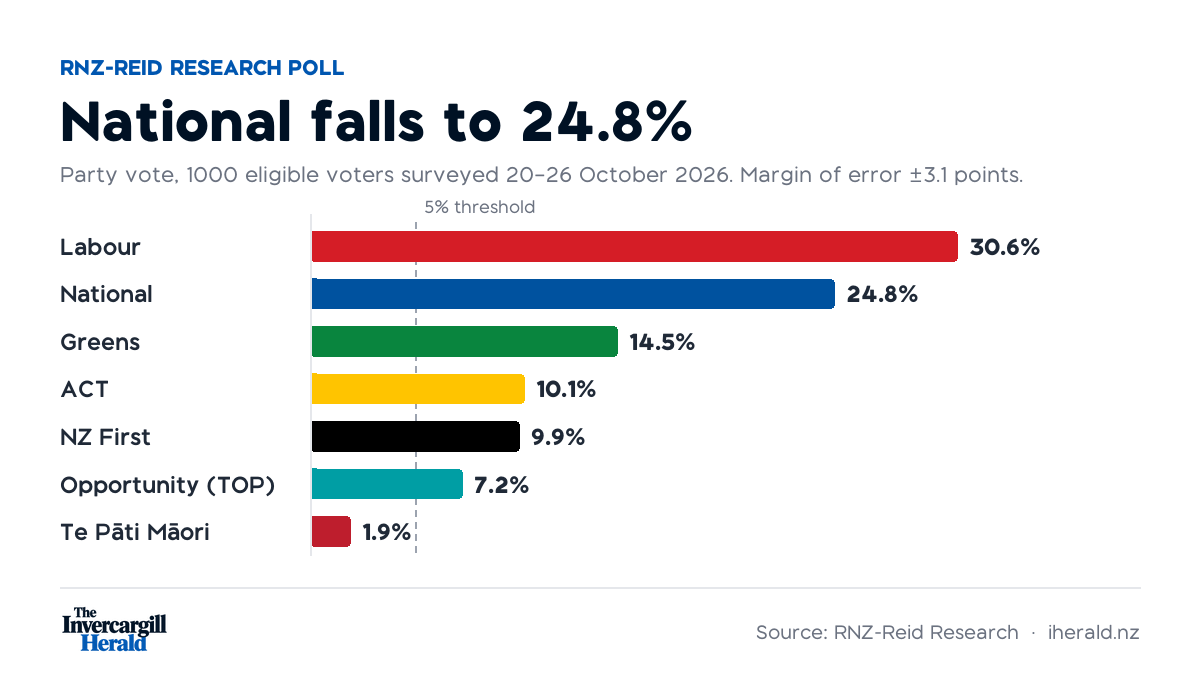
Reid Research surveyed 1000 eligible voters online between 20 and 26 October, with a maximum margin of error of 3.1 percentage points. A 1News-Verian poll taken over a similar period put National higher, on 29 per cent, with Labour on 27.
National's campaign chair Simeon Brown told RNZ the result was "out of step with most of the other polls that we're seeing, including our own". Labour leader Chris Hipkins said voters had "seen three years of this government. They don't want to see three more."
Prime Minister Christopher Luxon warned supporters on Thursday against treating the poll as a done deal, saying there would be dire consequences if the numbers became reality.
Chris Hipkins led Mr Luxon as preferred prime minister, 23.3 per cent to 17.1. Half of respondents said the country was heading in the wrong direction.
Advance voting opened on Labour Day. The Electoral Commission said more than 68,000 people voted nationwide on the first day, slightly ahead of the equivalent day in 2023. Advance voting runs until the day before the election, with election day itself on Saturday 7 November.


